Open die forging and ring rolling
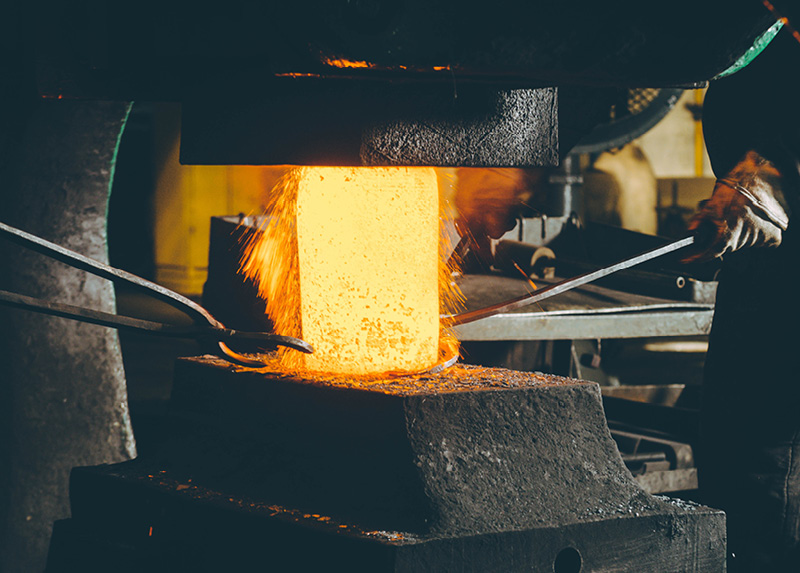
Open die forging shapes heated steel between flat dies while the workpiece moves between blows, so the grain follows the component geometry. The result is directional strength and integrity castings cannot match.
Sverdrup Steel delivers bespoke open die forgings and ring rolled components, flanges, blinds, blocks and rings in duplex & super duplex, austenitic, nickel alloy and low alloy grades, from a single prototype to a full project series, with express manufacture within seven days.
Every forging project is planned individually. The forging method, heat treatment and testing are matched to the grade and the application, production keeps you informed through each stage. A hire work service means your own material can be forged, heat treated and tested on request.
Why Choose Forged Components?
Forged integrity: The grain flows with the geometry, giving directional toughness and freedom from the porosity castings can carry.
Bespoke by design: Components are forged to your drawing, from a single prototype to project series, without pattern or die tooling investment.
Express manufacture: Selected bespoke forgings can be delivered within seven days when your project schedule demands it.
Material expertise: Duplex, super duplex, nickel alloys, carbon and low alloy grades forged with heat treatment and testing matched to the grade.
One supplier: Forgings arrive alongside our stock program and value-added services, from material testing to bored bars, cutting and container loading.
Forging materials and grades
Forging amplifies the grade. The grain is worked into the geometry, so the material choice settles toughness, corrosion resistance and heat treatment in one decision. These are the groups the forging service covers most, and each is backed by our own material program for the surrounding stock, testing and documentation.
| Material group | Why forging suits it | Common grades |
|---|---|---|
| Duplex & Super Duplex | Grain follows the geometry, giving directional impact toughness for chloride exposed flanges | F51, F53 & F55 |
| Austenitic | Fully wrought structure without cast porosity for pressure retaining flanges, rings and blocks | 316L, 316LN, 6Mo |
| Nickel alloys | Hot worked strength and corrosion resistance for severe service components | Alloy 625, Alloy 718, Alloy 725, Alloy X-750 |
| Carbon and low alloy grades | Proven forgemaster grades for flanges, blinds and blocks in pressure boundary duty | ASTM A350 LF2, ASTM A694 F65 |
Grade availability is project dependent. Contact us to discuss your specification.
Forging capability at a glance
Every forging project is matched individually, so capability is easier to show than to tabulate. The table summarises what the forging service delivers today, and exact envelope limits for a specific component are confirmed from your drawing.
| Parameter | Capability |
|---|---|
| Forging method | Open die forging with a wide range of hammers, plus ring rolling |
| Products | Bespoke forgings exclusively, forged to drawing from prototype to series |
| Express service | Selected bespoke forgings manufactured within seven days |
| Hire work | Customer supplied material forged, heat treated and tested on request |
| Heat treatment | Solution annealing and quench and tempering matched to grade and specification |
| Testing | Mechanical testing, non-destructive testing and dimensional inspection per specification |
| Machining | Rough and finish machining coordinated through our service network |
Exact envelope limits depend on grade and geometry, send us your drawing and we confirm what is possible.
Typical forged components
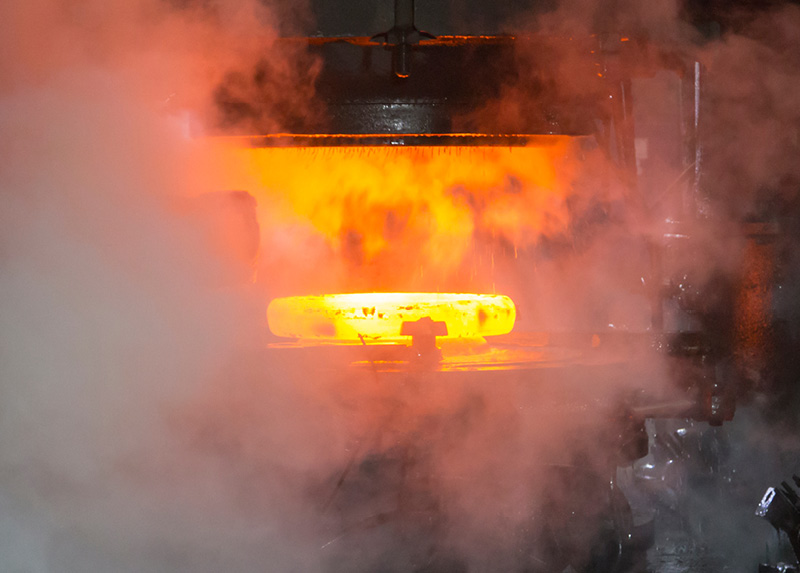
Industries served by forging
Whether it seals a subsea valve or carries load on a defence platform, a forging is chosen for duty where failure is not an option.
What changes between industries is the grade in the die, the testing behind it and the documentation that follows it, and what never changes is the integrity of the forged structure.
The table shows the sectors that build on forgings and what each of them asks of the component.
| Industry | Typical forged products |
|---|---|
| Oil and Gas | Flanges, blinds, blocks and rings for pressure boundary duty |
| Chemical | Flanges, rings and corrosion duty components in stainless and nickel grades |
| Marine | Ring and block components for seawater facing duty |
| Nuclear | Safety critical forgings with full traceability |
| Defence | High integrity components for demanding platforms |
| Aerospace | Structural forgings with full material documentation |
| General engineering | Bespoke solid forgings across every engineering sector |
Forging, Casting or HIP: Which Should You Choose?
Most suppliers can only sell you the process they happen to run. We deliver both forged components and hot isostatic pressed near-net-shape components, so the honest answer is available either way. The table summarises where each route wins.
| Criterion | Open die forging | Casting | HIP |
|---|---|---|---|
| Directional strength | Grain flow follows the geometry, giving the highest directional toughness | No grain direction, properties set by the casting structure | Fine and isotropic, strong in every direction |
| Internal soundness | Sound and proven, the traditional integrity benchmark | Risk of porosity and shrinkage defects | Practically no inclusions, porosity or segregation |
| Geometry freedom | Simple to moderately complex external shapes | High external complexity, internal quality limited | Near-net-shape geometry including internal channels |
| Size ceiling for solid parts | Heavy solid bespoke parts from a wide range of hammer and ring roller sizes | Large, but integrity becomes harder to guarantee | Limited by capsule and press volume |
| Tooling investment | No die or pattern tooling for open die work | Pattern tooling required for every design | Capsule and tooling prepared per component |
| Lead time for a bespoke part | Express manufacture within seven days on selected items | Pattern making adds weeks before the first casting | Project based, powder and capsule routing decide the schedule |
| Material utilisation | Machining allowance required around the forged shape | Near net, but pattern draft adds material | Near-net-shape means minimal material bought and machined away |
Unsure which route fits your component? Send us the drawing. We will recommend the process the part actually deserves, and both routes are ours to deliver.

Value-Added Processing & Services
A forging rarely travels alone. It lands in a project that needs the right grade in the surrounding stock, verified properties, machined interfaces and dependable logistics.
At Sverdrup Steel you consolidate the full scope with one supplier. We deliver duplex and super duplex, austenitic, nickel alloy, martensitic, heat-resistant and low alloy product ranges plus titanium, and our service centres and partner network cover processing from specification to delivery.
Explore our services relevant to forging projects below.
To specify the right grade around your forging, try our PREN calculator or the corrosion class guide, and see our NORSOK compliance work.
Your global supplier of high performance stainless steel.
Contact usAny questions? Contact our skilled team today.
Contact usF.A.Q.
-
What is open die forging?
Open die forging shapes a heated workpiece between flat or simply contoured dies while the workpiece moves between blows. Unlike closed die forging it needs no die tooling, so it suits bespoke single components and small series as well as very large forgings.
-
Can duplex and super duplex stainless steel be forged?
Yes. Duplex grades are forged with controlled hot working followed by solution annealing, which restores the balanced austenite and ferrite microstructure and the corrosion resistance. Forging gives the component directional grain flow and a toughness a casting cannot match.
-
Should my component be forged, cast or HIPped?
Forging gives the highest directional strength, casting wins on complex external shapes, and HIP gives near-net-shape components with practically no inclusions. Send us your drawing and we recommend the process the part deserves.
-
Can you forge our own material?
Yes. A hire work service means customer supplied material can be forged, heat treated and tested, with express manufacture available when needed.
-
What are the typical lead times?
Every project gets a plan and a time frame before work starts. Express manufacture of selected bespoke forgings is possible within seven days, and standard projects are scheduled to your programme.
-
What testing comes with a forging?
Mechanical testing, non-destructive testing and dimensional inspection per your specification, with certification such as EN 10204 3.1 and 3.2 available. Material testing and recertification are also part of our own service programme.